Spooked by Nicholas Schou
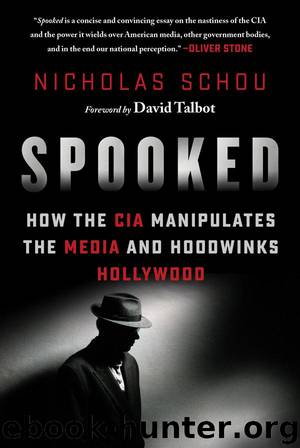
Author:Nicholas Schou
Language: eng
Format: mobi, epub
Publisher: Hot Books
Published: 2016-05-24T04:30:00+00:00
* * *
The truth, however, is that there were very few reporters on the national security beat like Risen who gave the Bush-Cheney administration any cause for concern. When the US invaded Iraq on March 20, 2003, much of the American press began to function as if they were the Pentagon’s unpaid publicists. Just as the US military orchestrated press conformity during the Persian Gulf War, nearly all reporters covering the Iraq War found they had no choice but to “embed” themselves with US forces—military jargon for the Pentagon’s post-Vietnam policy of only allowing reporters in combat areas if they were officially attached to a particular military unit. Not only were reporters, therefore, more limited in terms of their ability to serve as objective witnesses to the war, but they were also subject to both official censorship and the inevitable bias that comes with sharing a foxhole with your sources while being fired upon by the enemy.
“When you have the press in a hot box like we did in Vietnam and again in the Green Zone in Iraq, and whenever when the press is embedded, you are a hostage to the government,” said former CIA officer Frank Snepp. “Like Judy Miller: she thought what she had was too good to be true and it was. When she started to get leaks about WMD, she was in the same box that reporters in Vietnam were in. They had no way to corroborate such rarified access, because they had no other intelligence. It’s not that you own the press, it’s that the press has no way of owning itself and is utterly dependent on handouts.”
Although Vice President Cheney’s office had spearheaded the propaganda effort that drove the United States into the Iraq fire pit, the Pentagon took over media manipulation once ground fighting began, just as it had done during the Persian Gulf War. This was done mostly by strictly limiting journalistic access to combat areas and thus preventing the public from seeing the type of horrifying imagery that had helped undermine US support for the Vietnam War. Between September 1, 2004, and February 28, 2005, during which time nearly six hundred US soldiers died in combat, the nation’s six largest newspapers ran “almost no pictures from Iraq of Americans killed in action,” according to a survey by the Los Angeles Times.
Newspapers and television networks were even prevented from filming or taking photographs of flag-draped coffins being unloaded from the cargo holds of aircraft returning from Iraq. Meanwhile, as first exposed in 2005 by Jonathan Landay for Knight-Ridder, the US Army laundered payments through the Baghdad Press Club to pay Iraqi reporters to “produce upbeat newspaper, television, and radio reports” about the war. While not strictly illegal—the Pentagon can always justify propaganda operations when it can argue that doing so helps protect US boots on the ground—the officials involved in the program became worried that the ridiculous level of disinformation would backfire on the war effort, “undermining US credibility in Iraq” and potentially causing ‘blow back’ to the American public.
Download
This site does not store any files on its server. We only index and link to content provided by other sites. Please contact the content providers to delete copyright contents if any and email us, we'll remove relevant links or contents immediately.
| Anthropology | Archaeology |
| Philosophy | Politics & Government |
| Social Sciences | Sociology |
| Women's Studies |
The Secret History by Donna Tartt(19002)
The Social Justice Warrior Handbook by Lisa De Pasquale(12177)
Thirteen Reasons Why by Jay Asher(8874)
This Is How You Lose Her by Junot Diaz(6857)
Weapons of Math Destruction by Cathy O'Neil(6248)
Zero to One by Peter Thiel(5767)
Beartown by Fredrik Backman(5717)
The Myth of the Strong Leader by Archie Brown(5482)
The Fire Next Time by James Baldwin(5409)
How Democracies Die by Steven Levitsky & Daniel Ziblatt(5200)
Promise Me, Dad by Joe Biden(5130)
Stone's Rules by Roger Stone(5065)
A Higher Loyalty: Truth, Lies, and Leadership by James Comey(4937)
100 Deadly Skills by Clint Emerson(4900)
Rise and Kill First by Ronen Bergman(4761)
Secrecy World by Jake Bernstein(4727)
The David Icke Guide to the Global Conspiracy (and how to end it) by David Icke(4685)
The Farm by Tom Rob Smith(4489)
The Doomsday Machine by Daniel Ellsberg(4474)
